


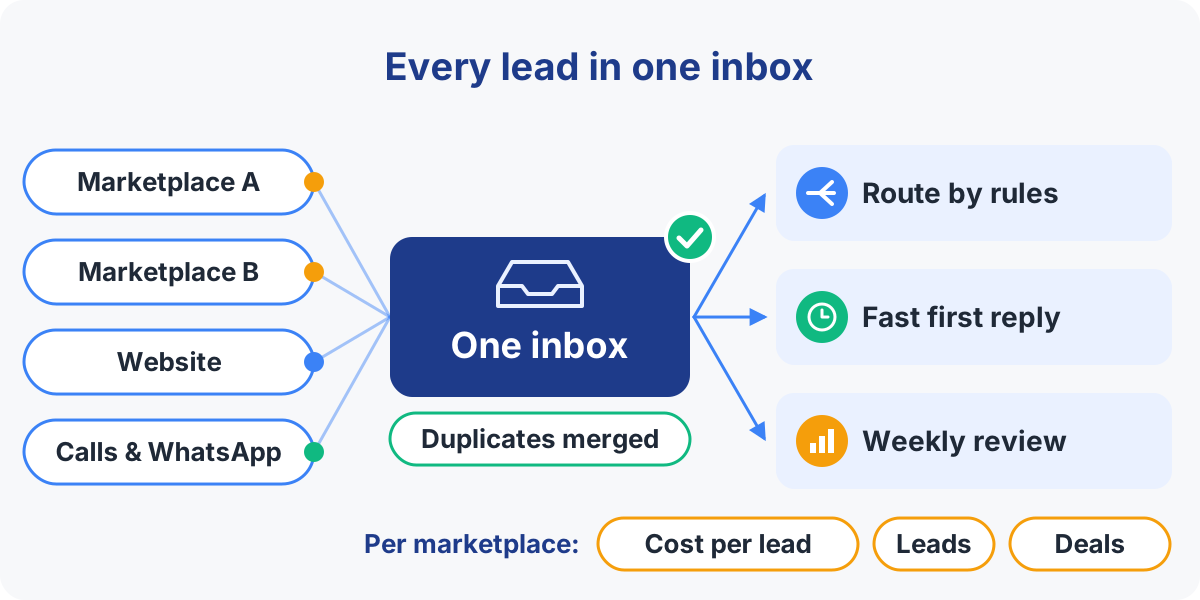
To manage leads from multiple marketplaces, bring every inquiry into one inbox, merge duplicates so each buyer exists once, route each lead to one salesperson by clear rules, set reply standards, and review each platform weekly on cost per lead and deals, not clicks. That is how dealers stop losing buyers between portals.
Key takeaways
- Listing the same truck on several platforms widens your reach, but every extra channel adds another stream of scattered inquiries.
- One inbox and one deduplication rule mean a buyer who asks on two platforms gets one salesperson and one answer.
- Routing rules by language, marketplace and price decide who replies before anyone has to think about it.
- Judge each platform on cost per lead and deals closed, not on views or clicks.

Why do dealers list the same stock on several marketplaces?
Because no single platform reaches every buyer: each one brings its own mix of local customers, export traders and specialists.
A used tractor unit, a three-axle curtainsider or a 20-tonne excavator rarely sells to the buyer next door. The person willing to pay the best price may be a haulier two regions away, an export trader shipping to another continent, or a contractor who only browses a portal dedicated to construction equipment.
That is why most dealers spread their stock across several channels:
- General vehicle portals for domestic buyers searching by make, model and price.
- Export-oriented platforms where traders from other countries look for volume and older units.
- Vertical niche sites for agricultural machinery, forklifts or plant, where the audience is small but highly targeted.
- Your own website, which buyers check once they have found you elsewhere.
A stock feed usually pushes the same listing to all of them at once, so publishing is easy. The difficulty starts afterwards.
In this article, a lead is any buyer contact about a unit: an email inquiry forwarded by a marketplace, a website form, a phone call or a WhatsApp message. Every extra platform adds reach, and it also adds another stream of leads arriving in its own format, at its own pace. Listing widely is a sound strategy. What breaks is the follow-up, which is why it pays to understand how lead capture works on each type of classified platform.
What goes wrong when inquiries come from many platforms?
Inquiries end up scattered, duplicated and unmeasured, so buyers wait, get mixed messages or quietly buy elsewhere.
Most dealers recognise at least one of these situations:
- The shared mailbox nobody owns. Notification emails land in a general address. Everyone can see them, so everyone assumes a colleague has already replied.
- A different format per platform. One portal puts the phone number in the subject line, another hides the buyer's email behind a relay address, a third only gives a listing reference. Someone has to read every message to work out who wants what.
- One buyer, two answers. A buyer asks about the same wheel loader on two platforms. Two salespeople reply with two different prices, and the buyer now trusts neither.
- Calls and WhatsApp floating free. The buyer saw the ad, then phoned or sent a WhatsApp message. Nobody records which listing or which platform started the conversation.
- No idea what actually sells. Each platform's dashboard shows views and clicks. None of them shows which leads became invoices.
The cost rarely shows up in one place. It is the Friday evening inquiry for a refrigerated trailer that waits until Monday, by which time the buyer has found another unit. Or the annual contract renewed with a platform that generates plenty of messages but hardly any deals.
None of this comes from lazy salespeople. It comes from a set-up where every channel has its own front door and nobody sees the whole buyer.

Shared mailbox, spreadsheet, CRM or lead manager: which works best?
A dedicated lead manager handles capture, duplicates and routing automatically, while a shared mailbox or a spreadsheet relies on manual discipline that breaks down as volume grows.
Here is how the four usual options compare on what matters for marketplace leads:
| Criterion | Shared mailbox | Spreadsheet | Generic CRM | Dedicated lead manager |
|---|---|---|---|---|
| Capture | Each email read by hand | Manual copy and paste | Partial, often needs custom parsing per platform | Automatic from marketplace emails, website, calls and WhatsApp |
| Duplicates | Spotted from memory, if at all | Manual search | Possible, depends on configuration | Merged automatically per buyer |
| Routing | Whoever opens it first | Assigned by hand | Rules possible after set-up | Instant rules by language, marketplace, price or channel |
| Reply speed | Depends on who is watching | Slow, copying comes first | Depends on set-up and discipline | Instant first reply, reminders and follow-ups |
| Per-marketplace reporting | None | Only if the source is typed in every time | Possible if the source is captured consistently | Built in: leads, cost per lead and deals per platform |
| Effort | No set-up, high daily effort | Little set-up, high daily effort | Significant set-up, medium daily effort | Moderate set-up, low daily effort |
A generic CRM is good at managing a pipeline of known contacts. For dealers, the hard part sits before the pipeline: reading dozens of notification formats, recognising the same buyer across platforms and linking a phone call to the right truck. That front end is what a dedicated lead manager is built for.
Aéllo Copilot is one example. It captures marketplace inquiries, website leads, calls and WhatsApp messages in one inbox, deduplicated so the same buyer never appears twice, and its integrations sync two-way with the CRM you already use.
To be fair, a small dealer with one salesperson and a handful of inquiries a week can manage with a well-kept mailbox. The case for a dedicated tool grows with the number of platforms, people and languages involved.
How do you centralise marketplace leads step by step?
List every channel, bring them into one inbox, agree one deduplication rule, set routing rules and response standards, then review each platform weekly.
- Inventory your channels. Write down every platform, website form, phone number and WhatsApp number, and who receives what today. There is usually a forgotten one, such as an old account still forwarding to a former employee.
- Create one inbox. Point every notification address, form and number to a single place where each lead has an owner and a status.
- Agree one deduplication rule. Two leads are the same buyer when they share an email address or a phone number written with its country code. A new inquiry from a known buyer joins the existing record and stays with its current owner.
- Set routing rules. German-speaking buyers go to the salesperson who speaks German, export platform leads to the export desk, units above a price threshold to a senior seller. Add a fallback when nobody picks up.
- Fix response standards. A target time for the first reply, an automatic acknowledgement outside working hours that names the unit, and a follow-up when the buyer goes quiet for a set number of days.
- Review weekly. Leads, cost per lead and deals for each platform.
Tip: Write the deduplication rule down and agree it with the sales team first. Most “that was my lead” arguments come from never defining what counts as the same buyer.
Software can run steps two to five for you. Aéllo Copilot, for instance, routes new leads instantly by language, marketplace, price or channel, sends an instant first reply, covers weekends and after-hours, and follows up automatically. The full list is on the features page.
What should you measure per marketplace every week?
Track three numbers per platform: genuine leads, cost per lead and deals, because together they show whether a platform sells or only generates traffic.
Clear definitions keep the review honest:
- Genuine leads: inquiries from real buyers, after removing duplicates, spam and obvious fraud attempts.
- Cost per lead: what you paid the platform over the period, divided by its genuine leads in that period.
- Deals: units sold to buyers whose first contact came through that platform.
From there you get cost per deal: platform cost divided by deals. It is the figure that matters most when the renewal comes up, and the one no platform dashboard will show you.
Clicks prove a platform is visible. Only deals prove it is worth paying for.
Two conditions make these numbers reliable. First, every lead needs its source recorded at capture, calls included: through a number dedicated to each platform, or by asking the buyer where they saw the unit. Second, duplicates must be merged; otherwise a buyer who asked on three portals is counted three times and every platform looks better than it is.
Lead management software such as Aéllo Copilot reports performance by channel, source and marketplace, with cost per lead and ROI per platform, so the weekly review becomes a quick check rather than a spreadsheet project. To estimate what tighter follow-up could be worth to your business, try the ROI calculator.

How do you decide whether to keep paying for a marketplace?
Keep a platform when its cost per deal is acceptable and it brings buyers you would not reach elsewhere; renegotiate or drop it when it brings volume without sales.
Before deciding, check four things:
- A long enough period. Truck and machinery deals can take weeks. Judge a platform over a quarter or more, not over one quiet month.
- Your stock mix. A niche portal for forklifts may send few leads, but if they are the right buyers for the units on your yard, it can beat a large general site.
- Unique buyers. Deduplication reveals overlap. If most buyers from one platform also contacted you through another, its real contribution is smaller than its lead count suggests.
- Your own reply speed. A platform can look weak simply because its leads arrived at weekends and waited. Fix the follow-up before blaming the channel.
Then put each platform into one of three boxes: keep (acceptable cost per deal, unique buyers), renegotiate or test a smaller package (leads but few deals, or heavy overlap) or stop (cost without deals over a full period).
Tip: Take your cost per deal figures to the renewal meeting. A platform's account manager will talk about views and clicks; invoices are much harder to argue with.
Handled this way, your marketplace budget stops being a habit renewed every year and becomes a decision you can explain.
Want every marketplace inquiry in one inbox, with nobody answering twice?