
Lead response time is the delay between a buyer's inquiry and your first relevant reply. For truck and machinery dealers it often decides the deal, because buyers send the same request to several dealers at once and tend to continue with the first one that answers their real question within minutes.
Key takeaways
- Buyers of used trucks and machines usually contact several dealers for the same type of vehicle, so your reply competes with others from the first minute.
- Fast means minutes during opening hours, plus a useful automatic reply in the evening and at weekends, followed by a personal call.
- A good first reply covers availability, price or finance, extra photos or video and an inspection invite, in the buyer's language.
- Measure first-response time per salesperson, per channel and per time slot, not only as one average for the whole team.
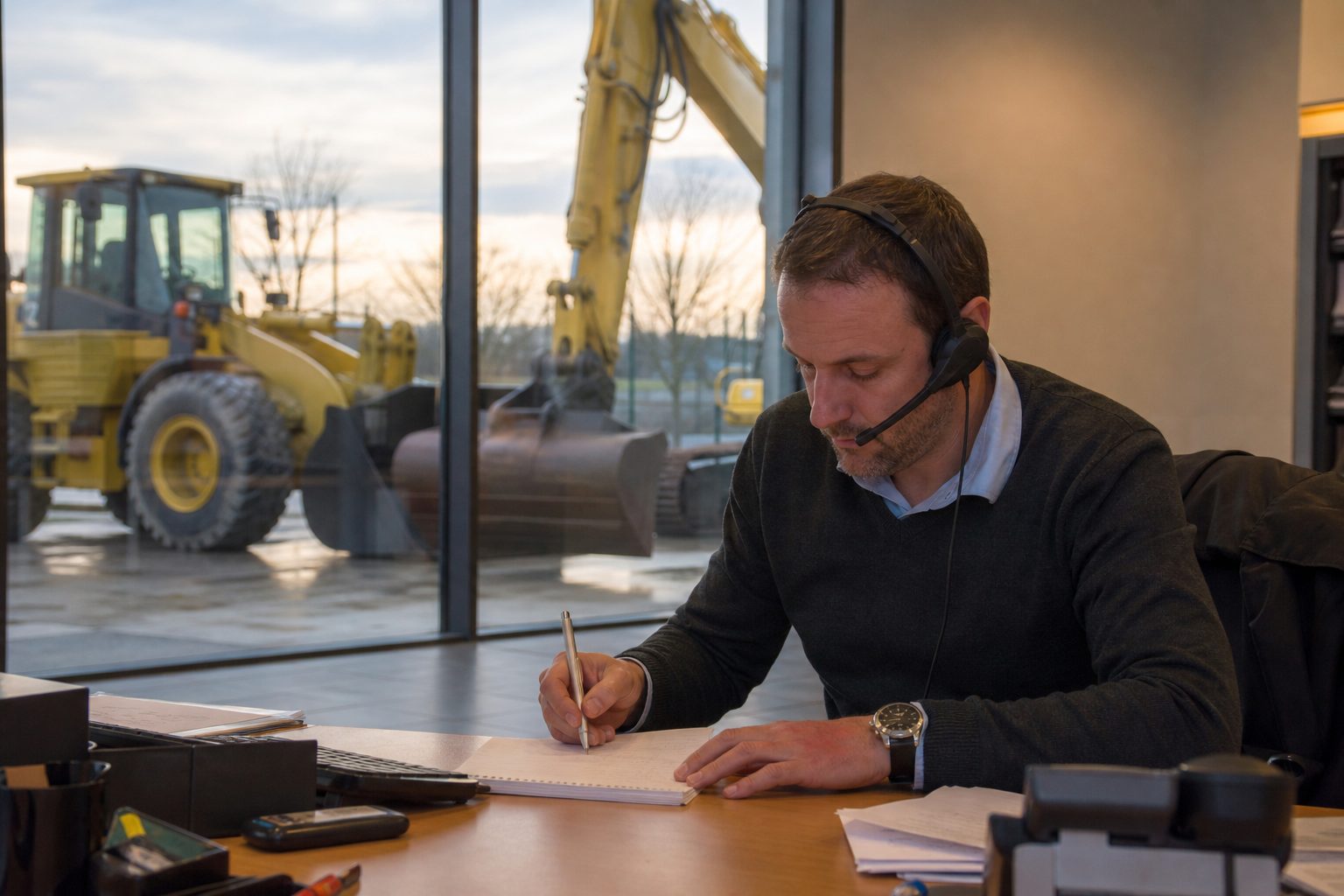
Why does the first relevant reply often win the deal?
The first dealer who answers the buyer's actual question sets the reference for price, condition and trust, and every other dealer then has to catch up.
A buyer looking for a three-axle tipper or a used telehandler rarely has time to spare. There is a job starting, a machine that has broken down or a fleet replacement planned. When the first useful answer arrives, the conversation starts: follow-up questions, extra photos, often a visit. The dealer who replies the next morning finds a buyer who is already negotiating elsewhere.
Research points in the same direction. In “The Short Life of Online Sales Leads”, published in Harvard Business Review in March 2011, Oldroyd, McElheran and Elkington found that companies that tried to contact a potential customer within an hour of receiving a query were nearly seven times as likely to qualify the lead as those that waited longer. The study looked at companies in general, not at vehicle dealers, but the logic is easy to recognise in truck and machinery sales: interest peaks at the moment of the inquiry and fades quickly.
The key word is relevant. A quick “thank you for your message” with nothing in it wins nothing. What wins is speed combined with substance: confirming the unit is still available, answering the price or finance question and proposing a next step.
Buyers rarely wait for the best dealer. They carry on with the first dealer who makes their decision easier.
Why do buyers contact several dealers for the same type of vehicle?
Used trucks and machines are listed on many marketplaces at once, so comparing offers costs a buyer only a few clicks and sending several inquiries is simply good practice.
Someone looking for a four-year-old tractor unit with a particular gearbox and mileage range will find comparable units from different dealers, often in different countries. Sending a handful of inquiries takes less time than studying one listing in detail. The buyer wants to know which units are really available, which prices have room and who answers clearly.
For a dealer, this has three practical consequences:
- You are always in a comparison. Even when a buyer writes only to you, they are probably looking at similar units elsewhere.
- The first exchange shapes the shortlist. Buyers tend to keep talking to the few dealers who replied clearly and quietly drop the rest.
- Cross-border buyers have less patience. A buyer writing in another language expects an answer they can understand, quickly, or moves on to a dealer who provides one.
If you advertise on several marketplaces and classified platforms, inquiries arrive in different formats and different inboxes. That fragmentation is often the real cause of slow replies: not a lack of motivation, but leads sitting in a mailbox that nobody checked on Friday afternoon.
What does “fast” mean in practice for a truck or machinery dealer?
Fast means minutes rather than hours during opening hours, and a useful reply in the evening and at weekends, when many buyers actually do their searching.
Many buyers are owner-drivers, contractors or farmers who work all day. They browse listings at night, on Saturday morning or on Sunday afternoon. If your team only answers between eight and five on weekdays, every inquiry sent on a Friday evening waits a whole weekend.
A workable definition has three layers:
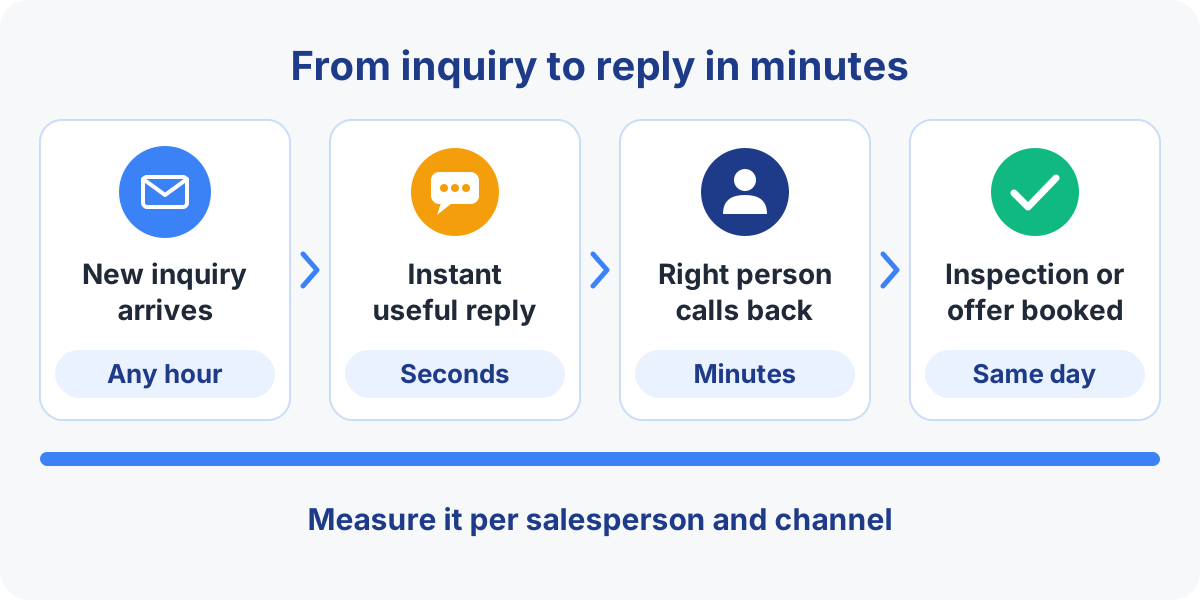
- Instant reply with substance: within seconds, the buyer receives a message that confirms which unit they asked about and gives them something useful, not just a receipt.
- First personal contact: during opening hours, a salesperson calls or writes within minutes. Set your own target and make it visible to the team.
- After-hours cover: in the evening and at weekends, either someone on duty answers, or the automatic reply gives a clear time for the call, such as “we will call you on Monday before 9:00”.
Each channel also needs its own reflex. An unanswered phone call is a lead lost on the spot unless someone calls back quickly. A WhatsApp message carries the expectation of a chat-style reply. A marketplace email has often gone to several dealers within the same hour.
Tip: Send a test inquiry to your own dealership on a Saturday evening, once through a marketplace and once through your website. Note when the first reply arrives and whether it actually answers the question. It is the quickest audit you can run.
How do you organise a fast response to every lead?
Bring every channel into one inbox, route each lead automatically to the right person, send a useful first reply at once and plan a fallback for missed calls and weekends.
One inbox for every channel
Marketplace emails, website forms, phone calls and WhatsApp messages land in one place, with duplicates merged, so the same buyer never gets three different answers.
Routing rules instead of “whoever sees it first”
Route by language, product type, marketplace or price range: German inquiries go to the salesperson who speaks German, cranes go to the crane specialist. Fair distribution keeps workloads balanced and stops the best leads from always landing with whoever watches the inbox most closely.
A first reply that is genuinely useful
Automatic replies work when they carry information: the unit's status, key specifications, a link to extra photos and a proposal for the next step.
Phone fallback and a missed-call list
If the assigned salesperson does not pick up, the call moves to a colleague. Calls that nobody answered go onto a missed-call list that is worked through first thing in the morning.
Weekend and after-hours cover
Decide who is on duty, or what the automatic reply promises, and keep that promise.
This is the core job of Aéllo Copilot: one deduplicated inbox for marketplace, website, phone and WhatsApp leads, instant routing by language, marketplace, price or channel, an instant first reply, evening and weekend cover, call scenarios that fall back to a colleague and automatic follow-ups when a buyer goes quiet.
What should a good first reply to a truck or machinery inquiry contain?
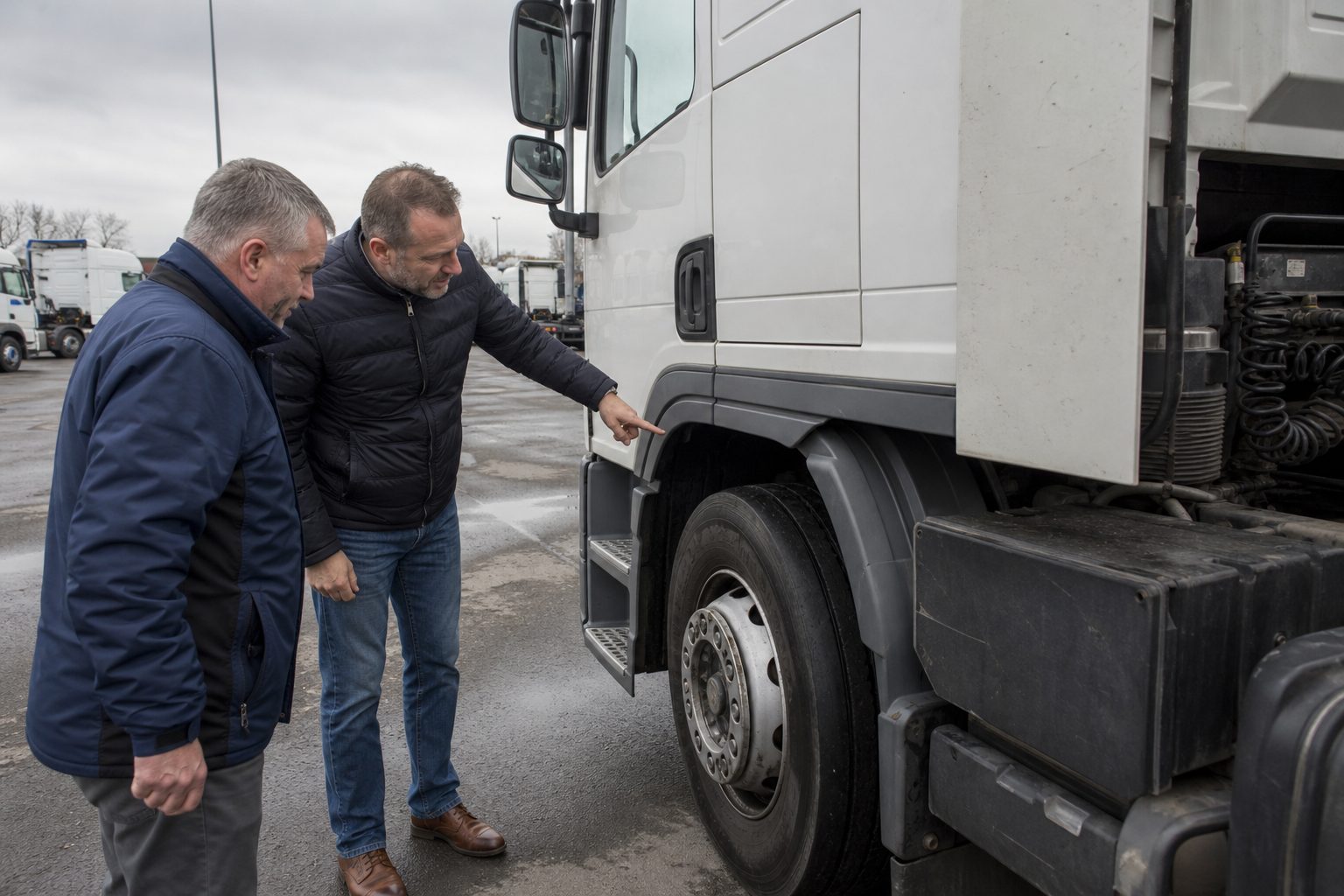
A good first reply answers the questions behind the inquiry: availability, price or finance, the real condition of the unit and when the buyer can come and see it.
Most inquiries are short (“Still available? Best price?”), but the buyer behind them is deciding whether a trip or a transport is worth it. Cover these five elements:
| Element | Why it matters | Example for a used tractor unit |
|---|---|---|
| Availability | The first question behind almost every inquiry | “The unit is available and can be inspected this week.” |
| Price or finance answer | Shows you take the question seriously | “The price is ex VAT, from our yard. Finance or lease options are possible.” |
| Extra photos or video | Replaces a first visit for distant buyers | “Here is a walkaround video plus photos of the chassis and tyres.” |
| Inspection invite | Turns interest into a concrete step | “Could you come on Thursday or Saturday morning?” |
| The buyer's language | Removes friction for cross-border buyers | A reply in German to a buyer who wrote in German |
Keep the message short and specific. Name the unit (make, model, year, stock reference), answer the question asked and end with one clear proposal rather than three options. If the unit has been sold, say so straight away and suggest a comparable one from stock: a live stock feed connected through integrations with your DMS or inventory makes that quick.
Tip: Prepare templates per product family (tractor units, trailers, excavators, farm tractors) and let the salesperson add one personal line. In Aéllo Copilot, templates, AI-assisted replies and automatic two-way translation let a salesperson answer each buyer in their own language without switching tools.
How do you measure first-response time per salesperson and per channel?
Log, for every lead, the time between its arrival and the first personal reply, then compare the results per salesperson, per channel and per time of day.
First-response time, often called speed to lead, only means something if everyone uses the same definition. Decide what counts as the first response: the automatic reply, or the first personal email, call or message. Track both, but manage on the personal one.
Then read the figures from several angles:
- Per salesperson: to see who needs support, fewer leads or a different schedule, not to name and shame.
- Per channel: phone, marketplace email, website form and WhatsApp behave differently, and missed calls deserve a line of their own.
- Per marketplace and source: to link response speed with conversion and with what each platform costs you.
- Per time slot: evenings, Saturdays and public holidays are where slow replies usually hide.
Look at the median as well as the average, because a single lead answered after three days distorts the picture. Review the figures weekly in the sales meeting, next to conversion, so that speed never becomes a goal on its own.
Aéllo Copilot reports performance by channel, source and marketplace, with conversion and funnel tracking and cost per lead per marketplace. To estimate what faster follow-up could be worth for your dealership, try the ROI calculator.
Want every truck and machinery lead answered in minutes, evenings and weekends included?