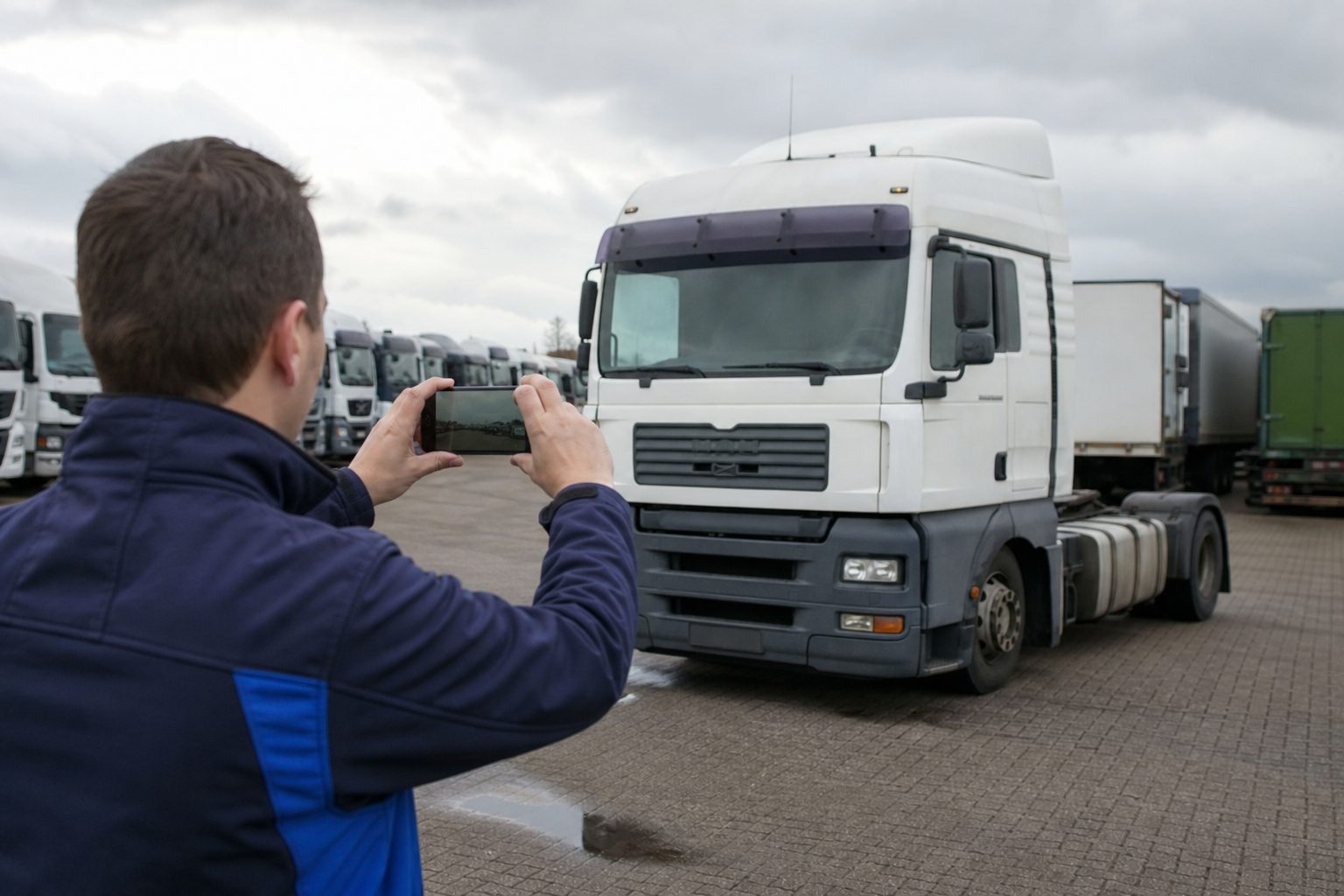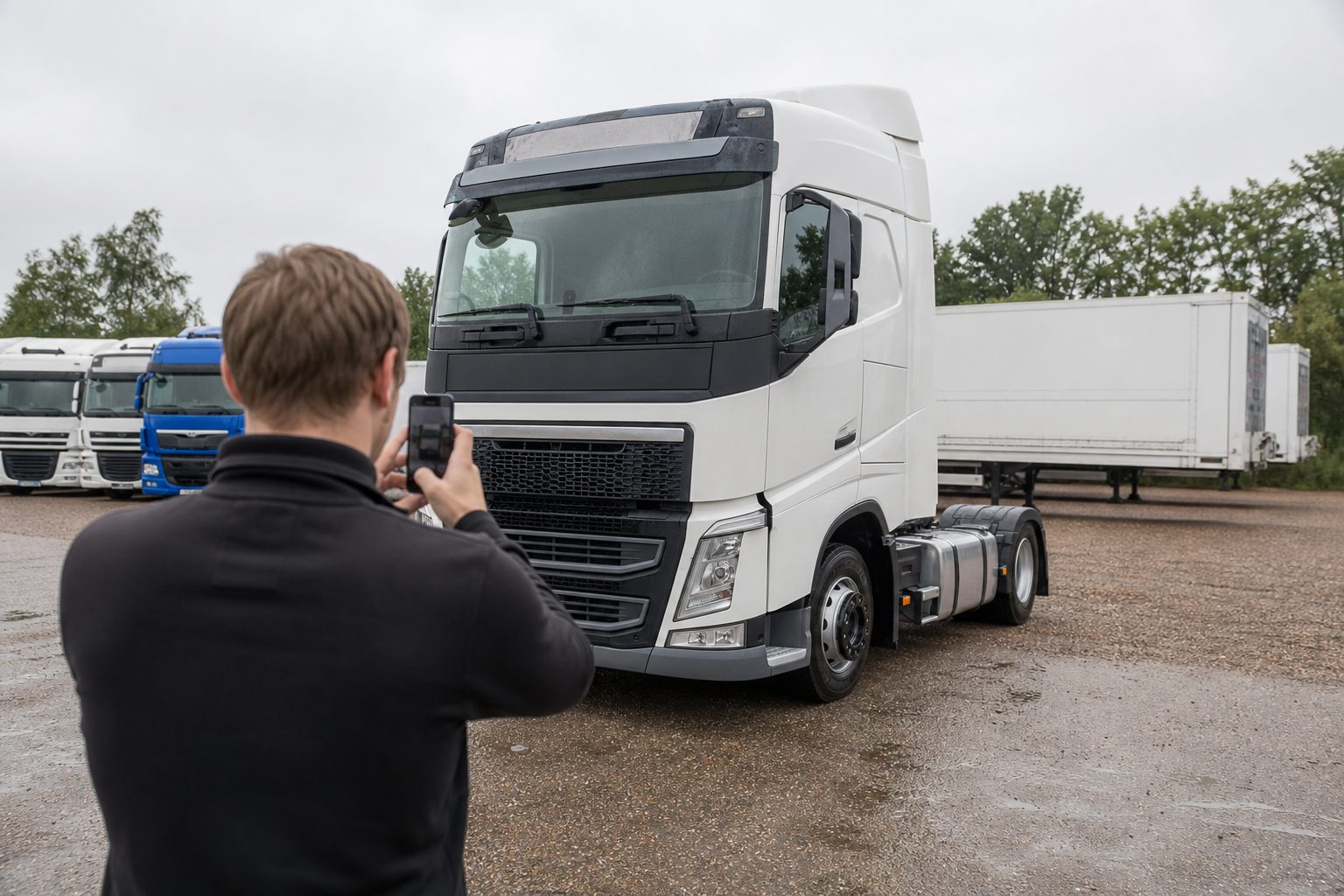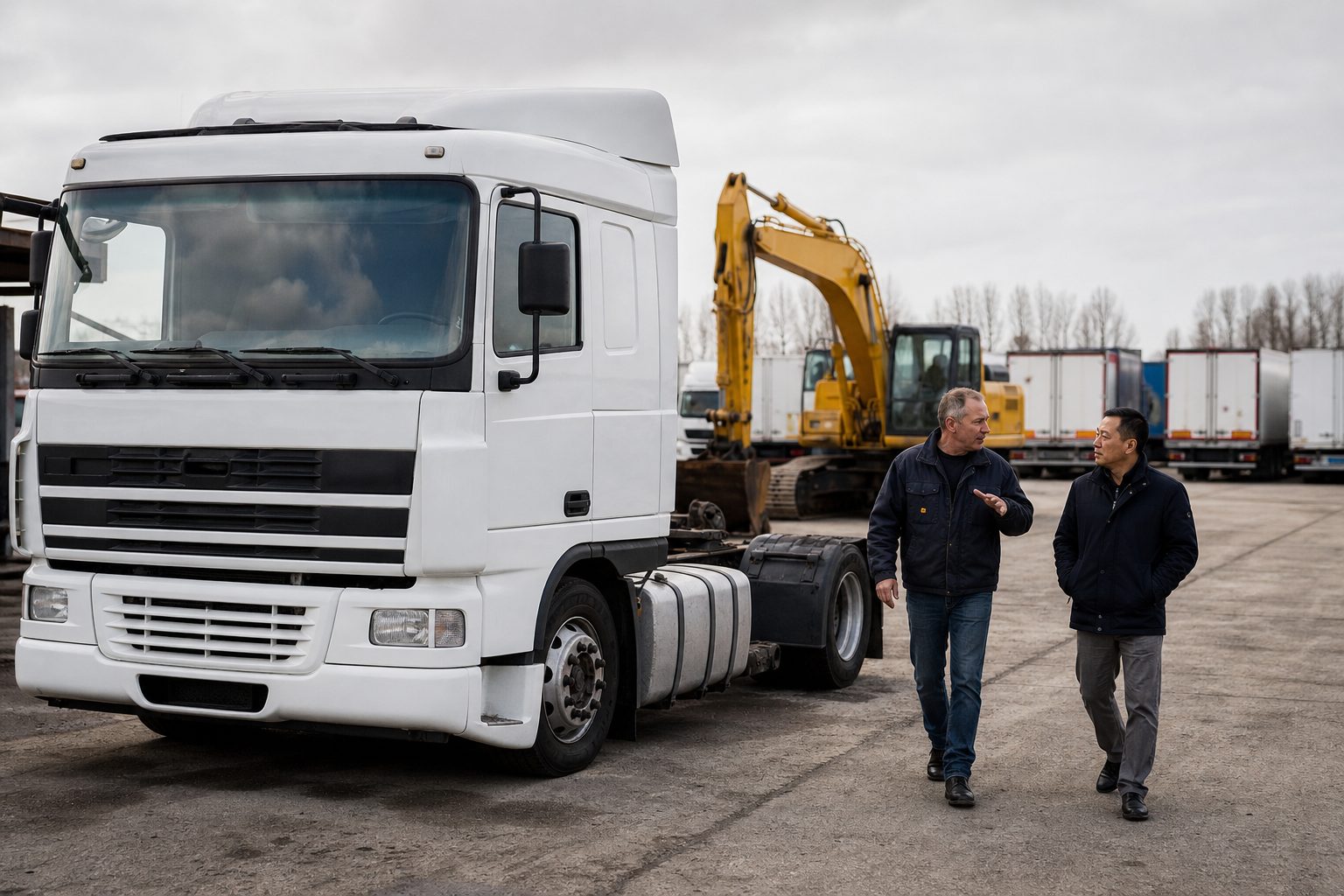
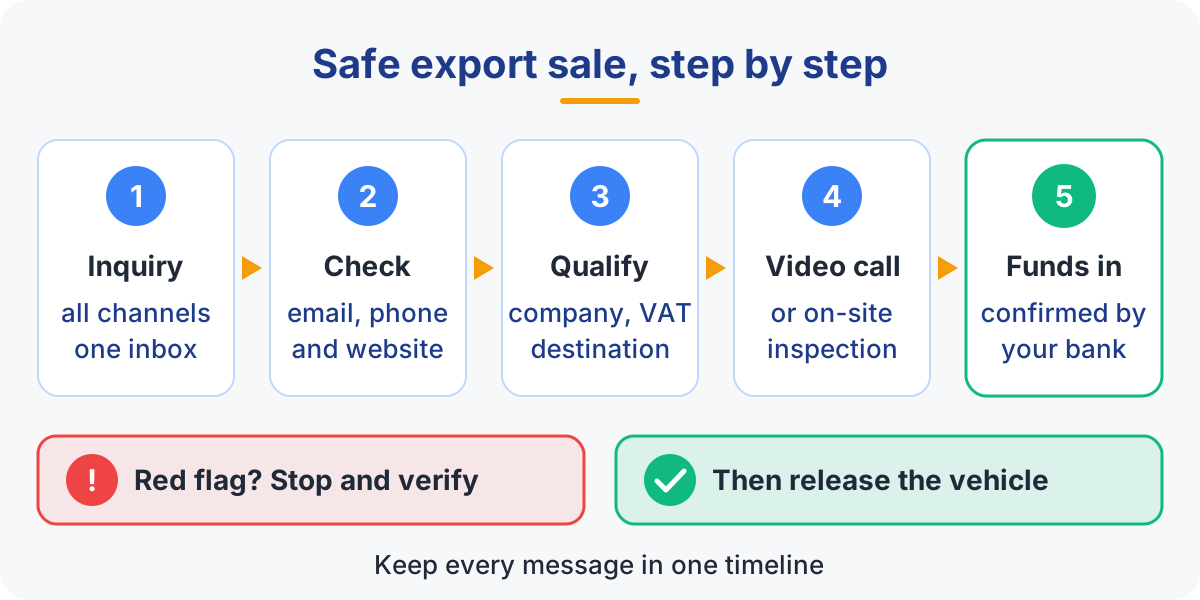
To qualify an export buyer of a used truck, trailer or machine, verify the company, its VAT or registration details, destination, timing and payment method, then insist on a call or video inspection. Never release the vehicle or its papers until your own bank confirms the funds are irrevocably credited.
Key takeaways
- Ask every export buyer the same short questions: company, VAT or registration number, destination, timing, payment and transport terms.
- A refusal to talk by phone or video, an overpayment or sudden urgency is a reason to slow down, not to speed up.
- Money counts only when your bank confirms it is irrevocably credited, never on the strength of a screenshot or a “transfer proof”.
- Verify any new bank details by calling a number you already know, and keep every exchange in writing in one place.
- Leave VAT treatment and proof of export to your accountant: guessing is where expensive mistakes start.
Why do used trucks and machines attract so many export inquiries?
Because used commercial vehicles and machines from the Benelux and France have a strong reputation abroad, and marketplaces show your stock to buyers far beyond your own country.
A well-maintained tractor unit from a Dutch fleet, a Belgian excavator with a full service history or a French refrigerated trailer often starts a second life in Eastern Europe, Africa, the Middle East or Central Asia. Buyers there value documented maintenance and European build quality, and many of them buy remotely, straight from an online listing.
For dealers this is good news. Export widens the market for older units, high-hour machines and specialist equipment that local customers pass on, whether you sell trucks, trailers or construction and agricultural machinery. It also means many inquiries come from people you cannot easily check: another language, another time zone, a free email address and sometimes no company name at all.
Most of these buyers are genuine traders, fleet owners or agents buying for clients. Some are not. Scammers like vehicle and machinery sales because the amounts are high, the goods can be moved quickly and the buyer is far away. If you advertise on several marketplaces, the same person may contact you through more than one of them, which makes the picture even harder to read.
The aim of qualification is not to treat every foreign buyer as a suspect. It is to sort inquiries fast, so your sales team spends its time on real buyers and spots the others before they cost you a truck.
How do you qualify an export buyer quickly?
Ask the same short set of questions every time, check the answers that can be verified, and note which questions the buyer avoids.
A consistent checklist protects you twice: it filters out weak or fraudulent inquiries, and it gives genuine buyers a professional impression. Serious traders expect these questions and answer them without hesitation.
| What to check | What to ask or do | Warning sign |
|---|---|---|
| Buyer identity | Full company name, registration number, website, named contact | Only a first name and a free email address |
| EU VAT number | Check it in the European Commission's VIES system | Invalid, or registered to another company |
| Destination | Country of final use and how the vehicle gets there | The country changes during the conversation |
| Timing | When they plan to pay and collect | “Today, or the deal is off” |
| Payment | Bank transfer from the buyer's own company account | Third-party payer, cheque or unusual channel |
| Inspection | Video call, visit or independent inspection | Refuses any call, buys unseen without questions |
| Transport terms | EXW or FCA, who collects, when and where | An “agent” you are asked to pay |
| Documents | Invoice, vehicle papers, export and transport documents | Wants the papers before paying |
VIES is the European Commission's free online tool for EU VAT numbers. It tells you whether a number is valid and, depending on the member state, can show the registered name and address. For buyers outside the EU there is no single equivalent: look for the company in its national business register, and check for a working website, a physical address and a switchboard number.
Note the answers in the lead record, not in someone's memory. When a colleague picks up the deal next week, they should see at a glance what has been checked and what is still open.

What do EXW and FCA mean in an export sale?
EXW and FCA are Incoterms, standard trade rules that state where your responsibility as seller ends and the buyer's begins.
Incoterms are published by the International Chamber of Commerce and used in contracts worldwide. For used vehicles and machinery, two terms come up again and again:
- EXW (Ex Works): you make the vehicle available at your yard. The buyer organises and pays for everything else, including loading, transport and export formalities. It is simple for you, but you have little control over what happens next, including the export paperwork.
- FCA (Free Carrier): you hand the vehicle over to the carrier chosen by the buyer at an agreed place, often your own yard, and you handle export clearance. It means a little more work, and more control over the documents that show the vehicle actually left.
Whichever term you use, write it in the order confirmation together with the named place, for example “FCA, our yard”. Vague wording such as “buyer collects” leaves room for argument when something goes wrong.
The choice can also affect VAT and the proof of export you need to keep (within the EU, a sale to a buyer in another member state is generally an intra-Community supply rather than an export, with its own proof-of-transport rules). Rules differ by country and by situation, so agree the term with your accountant before you quote, not after the truck has gone.
Tip: Never pay a buyer's “shipping agent” for transport, insurance or customs costs you did not agree to in writing. Under EXW and FCA, transport after handover is the buyer's business, not yours.
What are the red flags of an export scam?
Most export scams follow a few well-known scripts, and nearly all of them push you to act before money or identity has been verified.
- Overpayment, then a refund request. The buyer “accidentally” sends more than the price, or claims transport costs were included, and asks you to send back the difference. The original payment later bounces or is recalled.
- Pressure and urgency. A deadline appears out of nowhere: a ship about to leave, a customs appointment, an end client waiting. Urgency exists to stop you checking.
- No call, no video. Contact happens only by email or text, and there is always a reason why a call is impossible.
- Unverifiable agents or shipping companies. A transport “partner” with a brand-new website, a free email address or no traceable registration, who needs a fee from you before collection.
- Fake transfer proofs. Screenshots, PDF “bank confirmations” or payment messages that look official but never show up in your account.
- Changed bank details. A request to refund to a different account, or an email that seems to come from a known contact announcing “new” bank details.
- Cheques and unusual channels. Cheques, payments from a third party in another country, crypto, gift cards or money transfer services.
A real buyer wants to see the machine. A scammer wants to see your bank details first.
One flag on its own is not proof of fraud: a genuine buyer can be in a hurry or shy on camera. Several flags together are a clear signal to stop, verify and, if needed, walk away from the deal.
How do you get paid safely before releasing a vehicle?
Release nothing, not the vehicle, the keys or the registration documents, until your bank confirms that the funds are irrevocably credited to your account.
A balance that appears in online banking is not always final. Some payments can be recalled, and a cheque can bounce long after it seemed to be credited. Ask your bank, not the buyer, whether the money is definitively yours.
- Confirm with your bank. Use your bank's official channel or your account manager to confirm the payment is final.
- Verify bank details by phone. When anyone sends new or changed bank details, call them on a number you already had, never on the one in the email.
- Keep everything in writing, in one place. Offer, order confirmation, Incoterm, payment confirmation and handover note belong in one record a colleague can pick up.
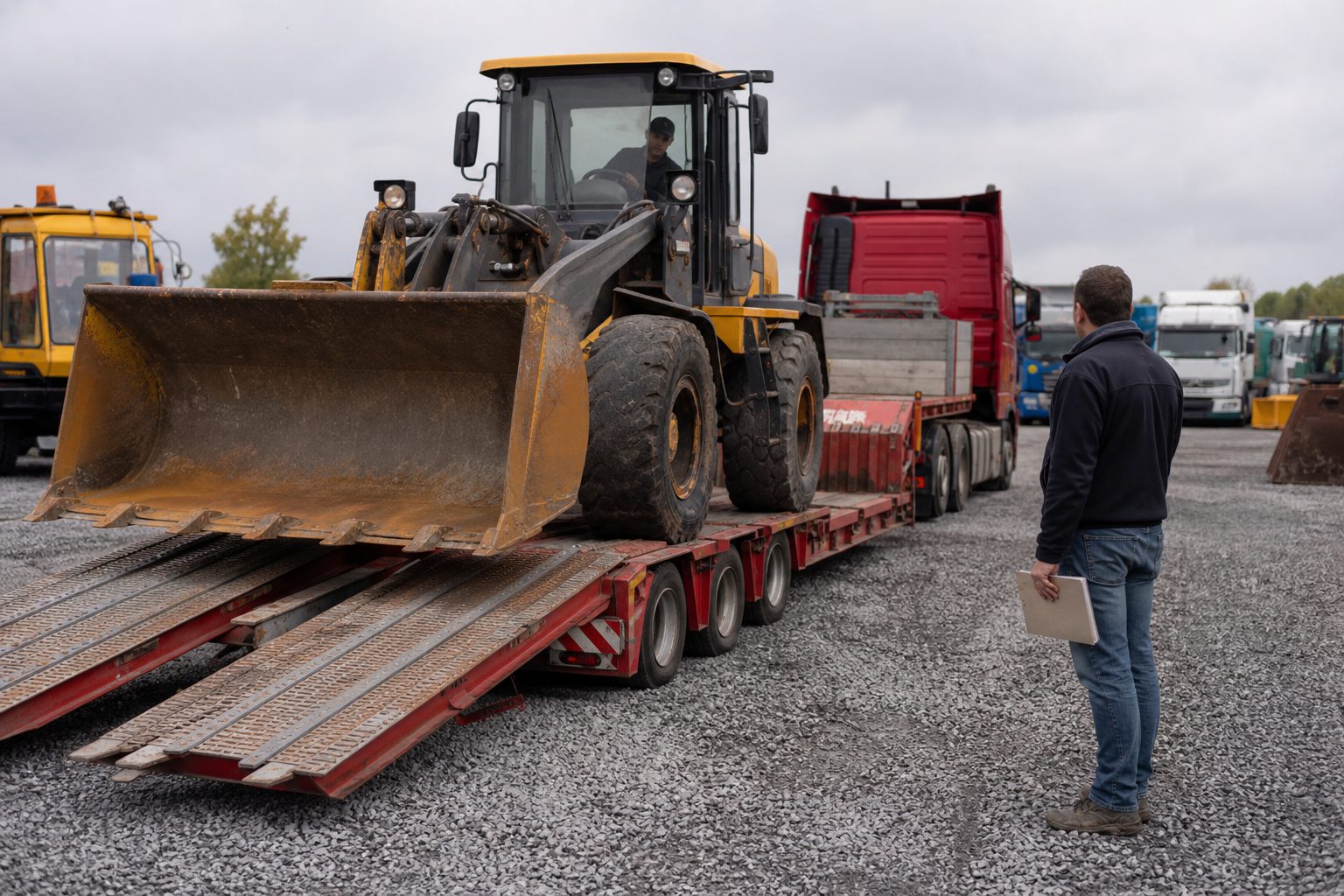
- Check who collects. Agree in advance on the transport company and driver, check their documents at pickup and record the handover.
- Ask your accountant. VAT treatment and proof of export depend on the buyer, the destination and the term used. Ask before you quote.
The third point is where a lead manager earns its place. In Aéllo Copilot, emails, SMS and WhatsApp messages with a buyer sit in one timeline, so the agreed price, the Incoterm and any bank details exchanged are visible to the whole team. If you already work with a CRM, two-way integrations keep that history in sync.
Tip: Make it a fixed rule that no vehicle papers leave the office until the accounts team has signed off the payment. It takes the pressure off the salesperson when a buyer pushes.
How do translation and trust checks help you focus on real buyers?
Translation lets you ask the right questions in the buyer's own language, and automatic trust checks show which inquiries deserve that effort first.
Export buyers write in many languages. A short, clear question in their language gets a better answer than a long English email, and it removes the excuse “I did not understand”. Use translation for the conversation, then confirm the key terms (price, Incoterm, payment) in writing so both sides read the same thing. Aéllo Copilot translates conversations automatically in both directions, so a salesperson can reply from the same timeline whatever language the buyer writes in.
Before anyone replies, a few signals already say a lot:
- Email: a company domain or a disposable address?
- Phone: a valid number, and does its country match the story?
- Digital footprint: a website, a company presence online, a trading history?
Checking this by hand for every inquiry takes time nobody has on a busy Monday. Aéllo Copilot runs these email, phone and digital-footprint checks automatically and turns them into a score, so real buyers rise to the top and obvious spam or fraud is filtered out. Because inquiries from every channel land in one deduplicated inbox, a buyer writing through several marketplaces appears once, not as a string of separate leads. The full list is on the features page.
A score does not replace your judgment or your bank's confirmation. It decides where your team looks first.
Want every export inquiry scored and checked before your team picks it up?